
If your agency is sending you a monthly report full of impressions, reach, and follower counts — and calling that ROI — you’re not getting ROI reporting. You’re getting activity reporting dressed up to look like results.
This is one of the most persistent problems in the industry. Social media measurement frameworks get built around what’s easy to pull from a dashboard, not around what actually matters to a business. The result is a CMO who can’t justify the budget in a board meeting, and an agency relationship that ends after 18 months because nobody can answer the question: “What did we actually get for that spend?”
We’ve managed social programs for brands like Hilton, KFC, Samsung, and National Geographic. What we know from that work is that measuring social media ROI is genuinely difficult — but it’s not mysterious. You need the right framework, the right metrics tied to the right business objectives, and an agency willing to be accountable to outcomes rather than outputs.
Here’s how it actually works.
Why Measuring Social Media ROI Is Harder Than It Looks
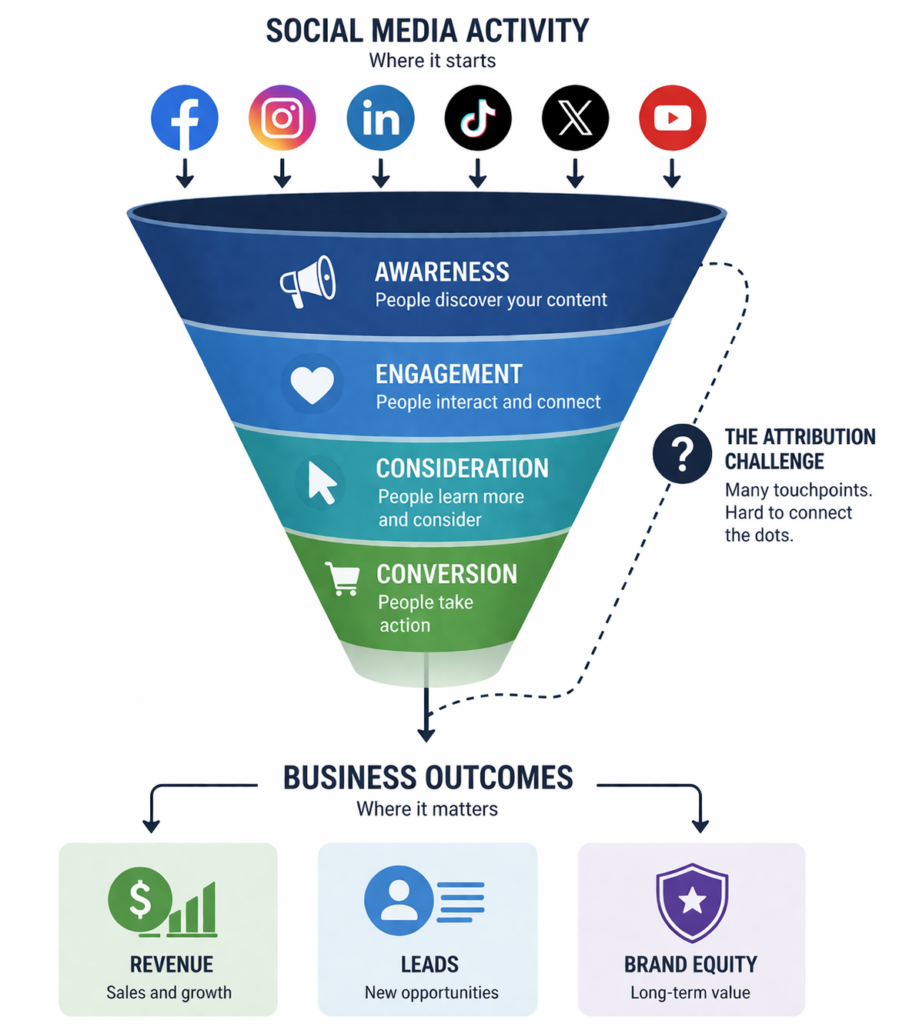
Start with the honest reality: social media sits at the top and middle of most purchase funnels. It influences consideration, builds preference, and triggers recall — but it rarely closes the deal alone. That multi-touch nature is what makes social media return on investment difficult to isolate cleanly.
A consumer sees a KFC post on Instagram, searches Google three days later, clicks a paid search ad, and converts. Last-click attribution gives zero credit to social. First-touch attribution gives it everything. Neither is correct.
Add to that the fact that different platforms track engagement differently, iOS privacy changes have degraded pixel-based tracking, and most brands are running social alongside email, display, search, and OOH simultaneously — and you start to understand why “social media ROI” is genuinely complicated to pin down with precision.
The solution isn’t to throw up your hands and default to vanity metrics. The solution is to build a measurement framework that accounts for these limitations honestly, uses the right proxies where direct measurement isn’t possible, and ties everything back to business objectives from the start — not after the fact.
The Two Types of Metrics — and Which One Actually Matters
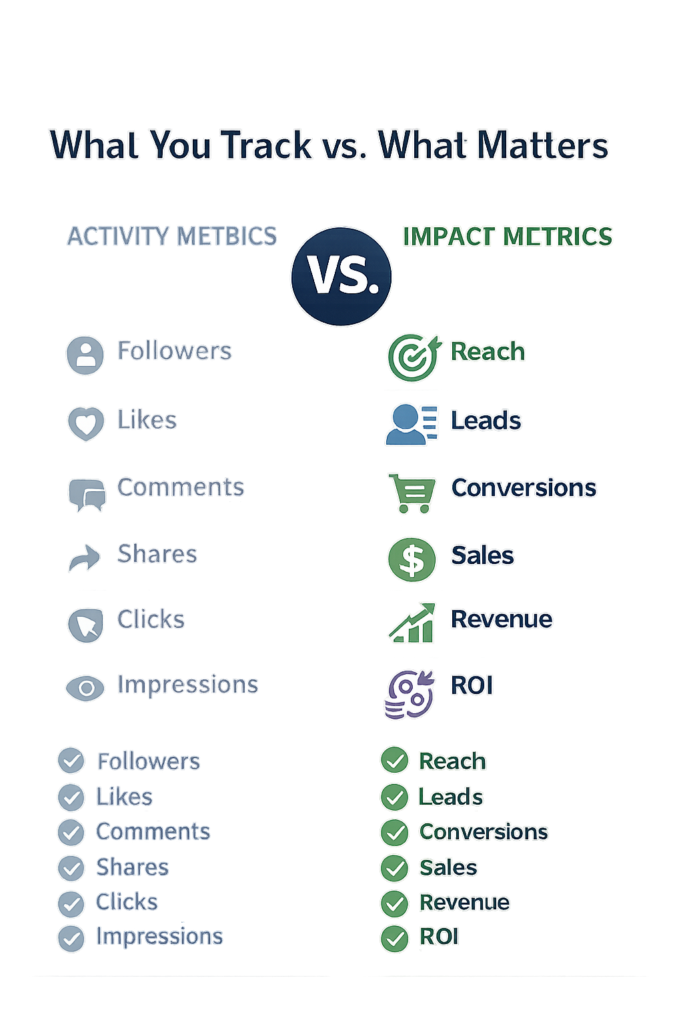
Every social metric falls into one of two categories: activity metrics or impact metrics. Understanding the difference is the foundation of any credible measurement approach.
Activity Metrics (Necessary but Not Sufficient)
- Impressions and reach
- Follower growth
- Post frequency and publishing cadence
- Likes, comments, shares
- Engagement rate by post
- Video views and completion rates
- Story views and swipe-ups
These metrics tell you whether your content is being seen and whether your audience is responding to it. They matter — but they don’t tell you whether any of it is doing anything for the business. A post with 2 million impressions that moves zero purchase intent is not a success. A post with 80,000 impressions that drives a measurable lift in branded search queries is.
Impact Metrics (The Ones That Matter)
- Website traffic from social (sessions, new users)
- Conversion rate from social traffic
- Revenue attributed to social (direct and assisted)
- Earned media value (EMV)
- Cost per lead or cost per acquisition from paid social
- Brand sentiment trends over time
- Share of voice relative to competitors
- Branded search volume (as a proxy for brand awareness lift)
- Customer retention and repeat purchase rates (for brands tracking LTV)
Impact metrics connect social activity to business outcomes. They require more sophisticated tracking setup, but they’re the only metrics that belong in an executive-level ROI conversation.
A note on earned media value: EMV is a legitimate impact metric when calculated correctly — using industry cost benchmarks to translate organic impressions and engagement into what equivalent paid placements would have cost. Strong influencer campaign management programs also generate EMV data that belongs in every executive ROI report. We’ve generated over $15M in earned media value for clients using this methodology. It’s not the only metric, but it’s one of the clearer ways to quantify the dollar value of organic social performance.
How to Build a Social Media Measurement Framework
A measurement framework is the document that maps your business objectives to your social KPIs and defines how each will be tracked, how often, and who owns the analysis. Without one, every reporting conversation starts from scratch. With one, your agency is accountable to the same benchmarks every month.
Step 1: Start with Business Objectives, Not Platform Metrics
What is the business trying to accomplish this year? Increase revenue from a specific product line? Improve brand perception in a new market segment? Reduce customer acquisition cost? The social measurement framework gets built backward from those objectives — not forward from what’s easy to pull in Sprout Social or Later.
Step 2: Assign Social’s Role in the Funnel
For most mid-market and global brands, social media is doing different jobs at different funnel stages simultaneously. Organic content builds awareness and brand preference. Retargeting via paid social moves warm audiences toward conversion. Community management protects brand sentiment and drives retention. Each role needs its own metrics — you can’t evaluate awareness content by conversion rate.
Step 3: Define Your KPIs, Targets, and Measurement Cadence
For each business objective, you need: a primary KPI, a target (based on historical performance or industry benchmarks), a measurement method, and a reporting cadence. Monthly reporting is standard; quarterly business reviews should include trend analysis and framework adjustments.
Step 4: Establish Baseline Before You Optimize
You can’t measure improvement without a baseline. Before launching any new social program or transitioning to a new agency, audit current performance across every channel. Document where you stand on every KPI you’ve defined. That becomes your benchmark against which all future performance is measured.
Step 5: Build in Attribution Infrastructure
UTM parameters on every link. Proper GA4 channel grouping. Pixel installation on key conversion pages. If you’re running paid social, platform-side conversion tracking in Meta, LinkedIn, TikTok, and Pinterest — with server-side tracking where possible to account for browser privacy limitations. This infrastructure has to be in place before the work starts.
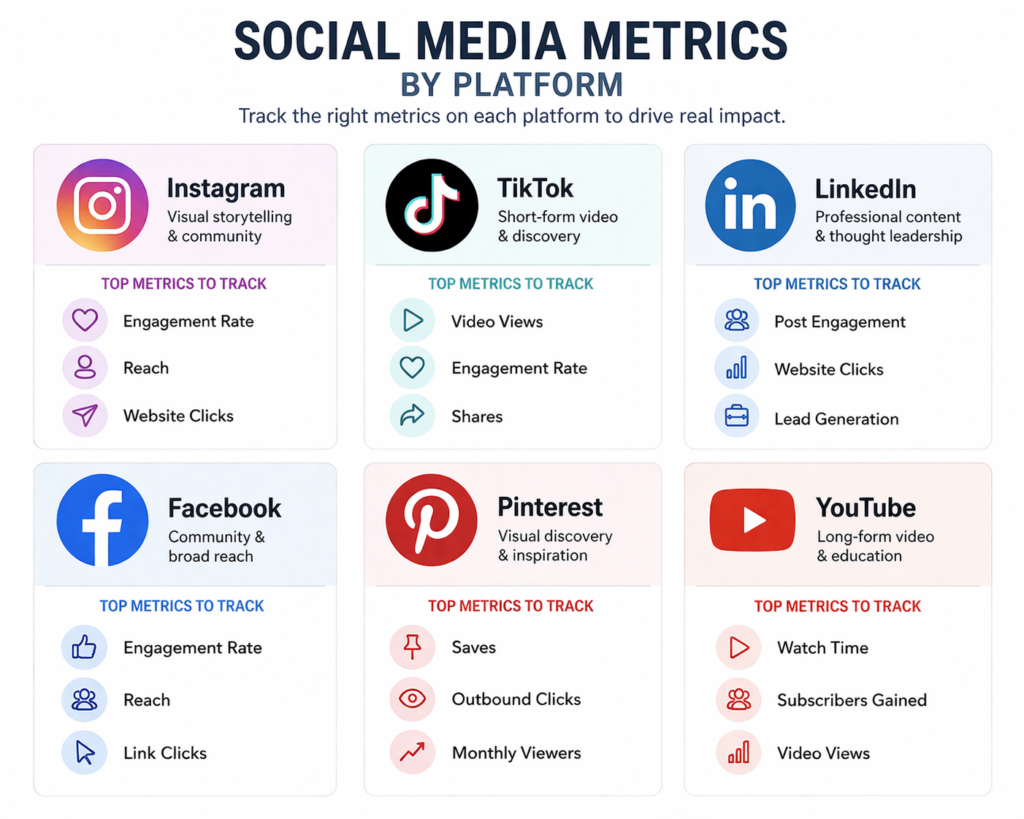
Platform-by-Platform: What to Track on Each Channel
Not all channels are doing the same job. Here’s what to prioritize by platform for a mid-market or global brand program.
Reach, saves (the strongest signal of intent), profile visits, link-in-bio clicks, Reels plays and shares, Story swipe-through rates, and DM volume for brands running conversational commerce. For paid: CPM, link click CTR, landing page conversion rate, ROAS.
TikTok
Video completion rate (the key signal of content quality on TikTok), shares, follower growth rate, profile visits, and traffic from profile link. TikTok’s native analytics now include website visits and conversions if you have the TikTok pixel properly installed. Watch time per video matters more than raw views.
For B2B-adjacent brands: impressions from target company and job title segments, follower quality (track demographic breakdowns), website clicks, and lead gen form completion rate. LinkedIn’s cost-per-lead benchmarks are higher than other platforms but the audience quality for B2B targeting is unmatched.
Organic reach has declined significantly, so Facebook’s primary value for most brands today is paid. Track CPM by audience segment, frequency (keep below 3-4 for brand campaigns), landing page conversion rate, and cost per result by campaign objective. Organic: comment sentiment and shares over likes.
For relevant categories (home, food, fashion, travel, CPG): saves as the primary signal, outbound clicks to site, and monthly viewers as a reach proxy. Pinterest drives purchase intent better than any other platform for in-category searches — track conversion paths from Pinterest traffic in GA4.
YouTube
Watch time (the platform’s primary ranking signal), subscriber growth rate, click-through rate on cards and end screens, and traffic driven to owned properties. For brands running YouTube pre-roll: view-through conversion rate and branded search lift measured via brand lift studies.
ROI Starts With the Right Social Media Strategy
Social media ROI is hard to measure when the program does not have a clear strategy behind it. Impressions, reach, clicks, engagement, leads, and conversions all matter, but they need context. The right KPIs depend on the goal, the audience, the platform, and the role social media plays in the buyer journey.
Fresh Content Society helps brands build social media programs with reporting in mind from the start. That includes strategy, content planning, channel management, campaign support, and ongoing social media marketing services tied to business goals.
How to Connect Social Media Activity to Business Outcomes
This is where most brands struggle most, and where the measurement framework either proves its value or falls apart.
Direct Attribution (E-commerce Brands)
If you’re running an e-commerce brand, you have the clearest path to social ROI. UTM-tagged links + GA4 + Shopify gives you direct revenue attribution by channel. Add platform-side ROAS reporting from Meta and TikTok Ads, and you have a fairly complete picture — just remember platform-reported revenue and GA4-reported revenue will not match, and you need to reconcile the difference.
Assisted Conversion Analysis
In GA4, look at social as an assisted channel in multi-touch conversion paths, not just last-click. The percentage of conversions where social appeared somewhere in the path — even if it wasn’t the last touchpoint — is a meaningful indicator of social’s contribution that last-click attribution misses entirely.
Incrementality Testing
For brands with the budget and sophistication to run it: geo-based holdout tests or Meta’s Conversion Lift studies measure incremental impact — what would have happened without the social spend. This is the gold standard for isolating social’s true contribution to revenue, and it’s the methodology that stands up in a board meeting.
Branded Search as a Proxy
Branded search volume in Google Search Console and Google Trends is a reliable leading indicator of brand awareness built through social. If you’re consistently producing high-quality social media content and organic impressions are growing, branded search volume should trend upward over 6–12 months. If it isn’t, something in the content strategy needs to be interrogated.
Brand Sentiment Tracking
Social listening tools (Brandwatch, Sprout, Mention) track brand sentiment at scale. For global brands managing significant community volume, sentiment trend lines over time — particularly before and after campaigns — are a quantifiable measure of social’s impact on brand health.
What Strong Social Media ROI Reporting Actually Looks Like
A strong monthly social media ROI report does not start with “here’s what we posted.” It starts with business performance.
- Executive summary — What moved this month against your KPIs? Up, down, or flat? Two paragraphs, no jargon.
- Business impact metrics — Revenue attributed to social (direct and assisted), leads generated, cost per lead, earned media value. These go first, not buried at the end.
- Channel performance vs. benchmarks — Each active platform compared against your defined benchmarks and prior-period trends. Not raw numbers — indexed against targets.
- Content performance analysis — What worked, what didn’t, and why. Specific posts, formats, and creative observations that inform next month’s strategy.
- Paid social summary — ROAS, CPL, or CPA by campaign. Spend efficiency analysis. Audience performance breakdown.
- Recommendations — What changes based on this month’s data? What’s being tested next period?
If your current agency’s report doesn’t include items 1, 2, and 6 every single month, you’re not getting ROI reporting. You’re getting a content recap.
Strong reporting also means your agency is telling you when something isn’t working — not just presenting the wins. Any agency that only surfaces good news in reporting is optimizing for account retention, not your business outcomes.
What FCS Measures for Clients
When a brand comes to Fresh Content Society for a social media management program, measurement setup isn’t an afterthought. It’s part of onboarding.
We build a measurement framework during the strategy phase — before content production begins, before a single post goes live. That framework defines the KPIs we’re accountable to, the benchmarks we’re measuring against, and the reporting cadence the client can expect. This is part of our b2b social media operations model — the governance layer that makes reporting accountable at every level of the organization.
Our social media strategy engagements include a full audit of current performance across channels, competitive benchmarking, and a defined measurement architecture that carries forward into execution.
For clients running paid social, we track ROAS, cost per lead, and cost per acquisition by campaign — and we report those numbers plainly, including when they’re underperforming and what we’re adjusting as a result.
Across our client portfolio, we’ve generated over $15M in earned media value, 2B+ organic impressions, and managed 10M+ followers. Those numbers come from programs built on measurement frameworks, not from inflated activity reports.
If you want to see what accountable social media reporting looks like in practice — let’s talk. And for context on investment, our social media management pricing guide breaks down what mid-market and global brands typically invest and what they get in return.
Real-World Example: How One Organic TikTok Drove an 11% Sales Lift for Chili’s
One of the clearest illustrations of social media ROI in action came from Chili’s. After a single organic TikTok video featuring their Triple Dipper went viral, the brand reported an 11% sales increase tied directly to the moment — without a paid media spend behind it. The video worked because it was native to the platform, made for the audience already on TikTok, and captured a genuine cultural moment rather than a polished ad read.
What’s worth pulling out of that example for any brand trying to measure social ROI: the lift wasn’t accidental. It was the result of consistent, native, platform-specific content creation that gave one piece a real chance to break through — exactly the kind of work a strong social media management partner is set up to produce. The ROI showed up because the content was built to feel human, not because it was built to feel like marketing.
The takeaway for measurement: tie your content to outcomes that matter to the business — sales, demo requests, branded search, foot traffic — not just views. The Chili’s example only became a story because someone connected an organic content moment to a hard revenue number. That’s the bar.
Frequently Asked Questions: Social Media ROI
What is a good social media ROI benchmark?
There is no universal benchmark because ROI depends on your industry, funnel stage, attribution model, and business objective. For paid social, a 3:1 ROAS is often cited as a baseline for e-commerce, but profitable programs at enterprise scale look very different than a direct-to-consumer brand. For organic social, benchmark against your own historical performance first — then against direct competitors using share of voice and engagement rate comparisons. Any agency promising you a specific ROI number before understanding your business model should be treated with skepticism.
How long does it take to see ROI from social media?
Paid social can produce measurable results within weeks if your conversion infrastructure is set up correctly — but sustainable ROAS typically improves over 60–90 days as audiences are refined and creative is tested. Organic social ROI is a longer game: brand awareness impact typically becomes measurable in branded search trends over 6–12 months of consistent, high-quality content. Social media is a compounding channel — the programs that generate the best long-term returns are built for durability, not short-term spikes.
What metrics should I use to measure social media ROI for a B2B brand?
For B2B brands, the most meaningful metrics are: LinkedIn lead gen form completions and CPL, website traffic quality from social (pages per session, time on site, conversion rate to demo or contact form), assisted conversions in your CRM attributed to social touchpoints, and branded search volume as a brand awareness proxy. FCS b2b social media agency approach ties every one of these metrics to pipeline — not just engagement. Follower count is meaningless in B2B contexts. Focus on pipeline contribution — what percentage of your sales pipeline had a social touchpoint somewhere in the journey.
How do I calculate earned media value (EMV) from social media?
Earned media value is calculated by taking your organic impressions and engagements and applying industry cost benchmarks to determine what equivalent paid placements would have cost. For example, if your CPM on paid Instagram is $8 and you generated 5 million organic impressions, your EMV for those impressions is $40,000. What matters is using a consistent methodology over time so the trend line is meaningful — EMV is best used as one indicator among several, not a standalone success metric.
Can social media ROI be measured without e-commerce tracking?
Yes, though it requires more sophisticated approaches. The best proxies for non-e-commerce brands are: website conversion events in GA4 (form fills, phone calls, content downloads), branded search volume trends in Google Search Console, social listening sentiment analysis, and GA4 multi-touch attribution to assign partial credit to social touchpoints even when the final conversion happens via another channel. Attribution modeling in GA4 handles this reasonably well for most programs.
What is the difference between social media ROI and social media KPIs?
KPIs are the metrics you track; ROI is the value calculation that connects those metrics to business outcomes. An engagement rate is a KPI. The revenue generated by an audience with an above-average engagement rate, tracked through a conversion funnel, is ROI. KPIs are inputs to ROI measurement — they tell you whether the work is performing — but they don’t tell you what the work is worth to the business. The confusion between the two is why so many brands end up with agencies reporting high KPIs while delivering unclear business value.
Should I use the same social media ROI framework for organic and paid?
No. Organic and paid social serve different roles, operate on different timelines, and should be evaluated against different benchmarks. Paid social ROI is typically measured in direct terms: ROAS, cost per lead, cost per acquisition. Organic social ROI is measured in brand equity terms: earned media value, brand sentiment, share of voice, branded search lift. A strong measurement framework evaluates each on its own terms rather than forcing both through the same ROI calculation.
How should I evaluate whether my current social media agency is delivering ROI?
Start with your reporting: if your agency cannot tell you what revenue or pipeline impact social has contributed in the last quarter, that is a measurement failure. Ask to see the measurement framework they built for your program and what KPIs they are accountable to. If you’re evaluating whether to keep your current agency or make a change, our guide on agency vs. in-house social media management covers the accountability structures you should expect from either model.
What tools do I need to measure social media ROI properly?
At minimum: Google Analytics 4 with properly configured conversion events and UTM parameters on all social links, native analytics from each active platform, and a social media management platform with reporting capability (Sprout Social, Hootsuite, or Later). Google’s new Source Group also makes platform-level attribution cleaner. Read our breakdown of the Google Analytics social media tracking update and what it means for marketers. For more sophisticated programs, add a social listening tool for sentiment tracking, a CRM with UTM tracking to tie social leads to pipeline, and Google Search Console to monitor branded search trends. Build the infrastructure in order of your measurement priorities — you don’t need all of it on day one.
How much does a social media agency charge for ROI reporting and measurement?
Measurement and reporting infrastructure is typically included in full-service social media management retainers. What varies is the sophistication: an agency charging $2,000/month is likely providing platform-native data exports, while an agency at $8,000–$15,000/month should be delivering custom dashboard reporting, GA4 attribution analysis, and quarterly business reviews. Our social media management pricing guide breaks down what different investment levels include in terms of reporting depth.
Fresh Content Society is a senior-led social media management agency helping mid-market and global brands build social programs tied to measurable business growth. We’ve managed 10M+ followers, generated $15M in earned media value, and driven 2B+ organic impressions for clients including Hilton, KFC, Samsung, and National Geographic. Explore our services →
Tracking the right metrics only matters when your social media strategy is built around real goals. Fresh Content Society’s social media marketing services are built to connect every piece of content to measurable business outcomes.
Need clearer social media reporting? FCS helps brands connect strategy, content, campaigns, and reporting so your team can see what is working and what should improve next.
About the Author
Scott Emalfarb
Founder & CEO, Fresh Content Society
Scott Emalfarb is the Founder & CEO of Fresh Content Society, a social media marketing agency he built over 16 years in the digital marketing industry. Scott leads a senior team that has generated 90M+ video views, $15M in earned media value, and consistent 9%+ engagement rates for retail, CPG, automotive, B2B, manufacturing, and construction brands across the country. His approach centers on building social media programs that function as real business systems — not just content calendars.
Connect with Scott on LinkedIn →
Measuring ROI looks different depending on your industry and buyer. FCS builds reporting frameworks for manufacturing and industrial companies and B2B brands where success is tied to lead quality and pipeline influence, not vanity metrics.